


Buying guide2 min read
How to choose an AI automation partner: ten questions to ask
AI automation is a young market, and the pitch decks look alike. These ten questions separate partners who will do the work from those who will sell you the demo.
#The ten questions
- 1What exactly will be running in my business, and where?
You should be able to point at it: which server, which accounts, which channels.
- 2Whose name is everything in?
If the answer is the vendor’s, you are renting. See owning your AI.
- 3Who watches it after launch?
Ask for a named person and a weekly review, not a support inbox.
- 4What can it not do?
A good partner can list what must always go to a human.
- 5How will I hear its voice before customers do?
Look for a draft period where nothing goes public until you approve it.
- 6What does it say about being an AI?
It should always disclose, and outbound contact should be consent-based.
- 7How is the price built, and what is passed through?
Provider costs should appear at cost, separately from the partner’s fees.
- 8What is in scope, and what is written down as out of scope?
A quotation that lists exclusions is a quotation that expects to be held to.
- 9What do I get if I leave?
The honest answer is the server, the accounts and the content.
- 10What have you actually delivered?
Be wary of a wall of logos from a young company. Ask what you can watch being built for you.
#Red flags
- Guaranteed results or revenue numbers before they have seen your business.
- “Set it and forget it” — nobody should be unsupervised with your customers.
- A flat fee that bundles AI usage, so you cannot see what is pass-through.
- No written scope, or a scope that cannot be turned down.
- Pressure to sign on the first call.
You can see how we answer these in our Complete Guide, and test us on them on a free audit call.
Keep reading
 The basics
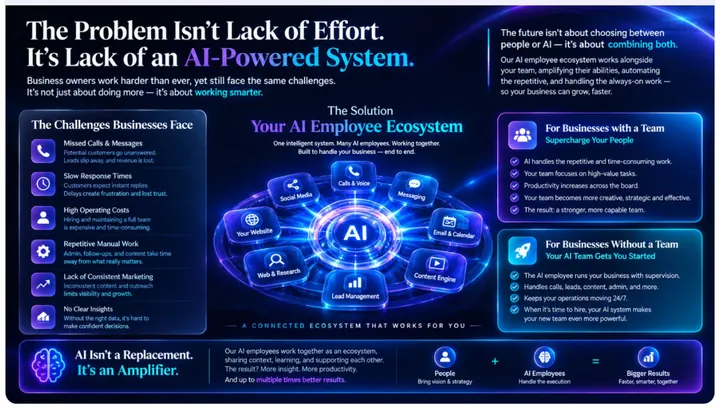
What is an AI employee? (And how it differs from a chatbot)
An AI employee does ongoing work across your channels — replies, follow-ups, bookings, posts — inside rules you set. Here is how it differs from chatbots and automations.
 The basics
What a missed call really costs a small business
A worked way to put a number on missed calls, slow replies and after-hours enquiries — and the cheapest fixes, from voicemail rules to an AI receptionist.
 The basics
Speed to lead: why replying in five minutes changes everything
What the research on lead response time actually says, what it does not, and how a small business can reply to every new enquiry within minutes — at any hour.